More of the God, human, animal bond (the GHAB™)
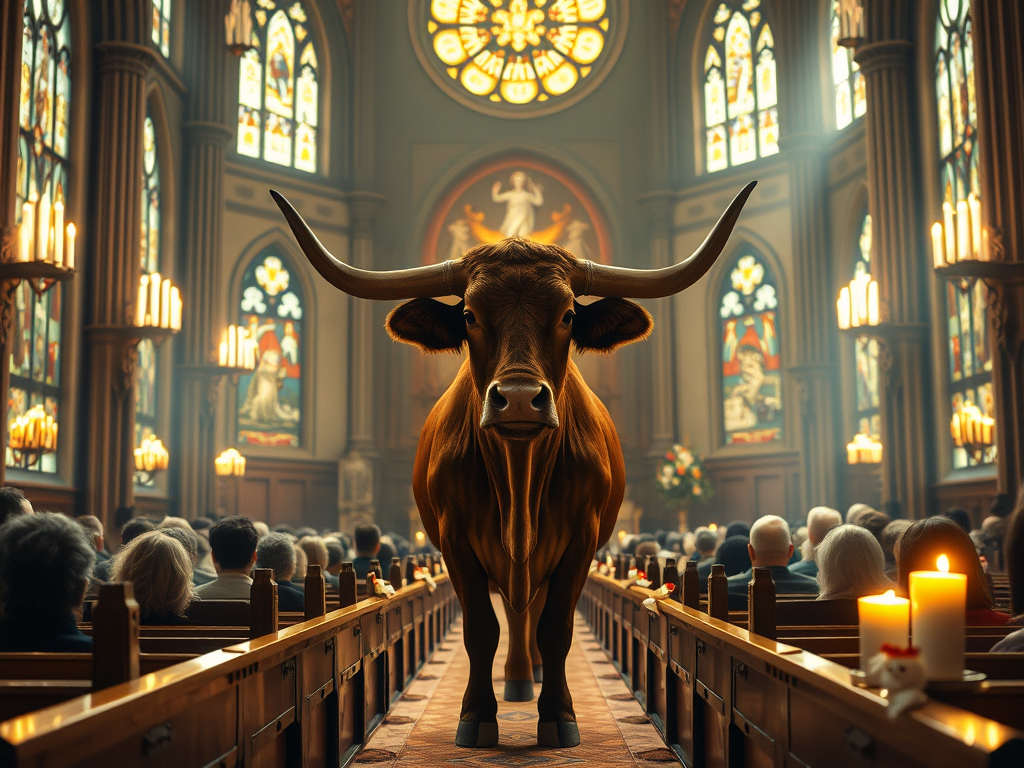
When we walk into a church sanctuary, most of us expect familiar sights: candles, crosses, stained glass, pews, and people. But what happens when animals step across that threshold, when they are not just symbolic, but actually present, breathing and moving around?
Laura Hobgood-Oster, Professor of Religion and Environmental Studies at Southwestern University, invites us to wrestle with that question. Her work helps us see that what I call the God–Human–Animal Bond (The GHAB™) is not just a modern idea but is deeply rooted in Christian history and ritual. In other words, our faith story has always been more-than-human.
ANIMALS AT THE HEART OF THE RITUAL
Hobgood points to powerful examples where animals literally stand at the center of Christian practice. She describes the Ox of Saint Zopito (Il Bui de San Zopito) and writes:
“Il Bui de San Zopito, the Ox of Saint Zopito, marks every aspect of San Zopito’s commemoration and brings living animals to the heart of Christian ritual and story.”
In this ritual, the ox doesn’t just appear as decoration. He shapes the celebration itself, from the way the festival unfolds to the final act of depositing a pile of manure in the sanctuary before returning home.
This is shocking to many of us. Manure in the sanctuary? Even an ox procession through the streets? Yet Hobgood notes that this “animal-rich ritual begs for interpretation and participation.” It forces us to ask not just what the ox is doing there, but what his presence says about us.
She poses the question:
“From the final act of depositing a pile of manure in the sanctuary to the ox’s return, why look at animals within the history of the Christian tradition at all?”
Why, indeed?
Within the GHAB™ framework, this question uncovers something crucial: human identity is relational. We understand who we are not in isolation, but in dialogue with the “other,” and that “other” is not limited to other humans. It also includes animals.
Leave a Reply