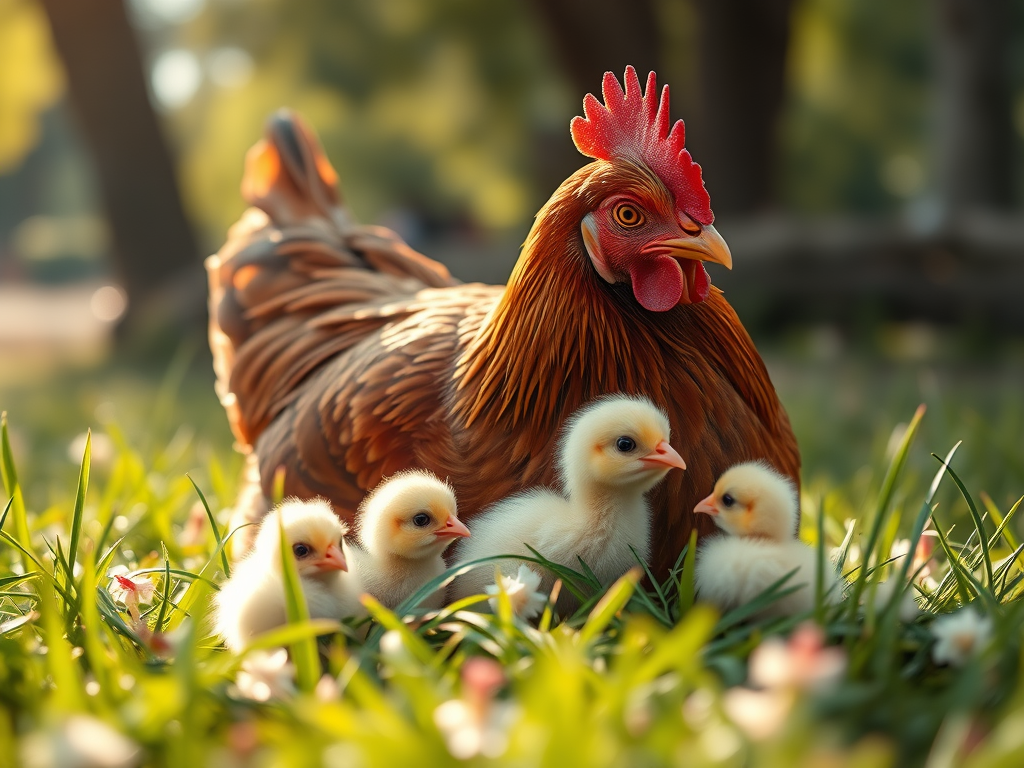
Some stories cut us to the core. Yet, we must re-imagine these stories in the light of Christ’s love, as we retell them.
This one began with two small, fertilized eggs, gifted from a friend. Yet, through them, the Lord invited me to see the God–Human–Animal Bond (the GHAB™) more intimately, all through the life and death of a single hen.
The Two Eggs
Carefully, we tucked the eggs beneath one of our older hens, trusting what God had already written into her: instinct. For 29 days, she kept them warm, even at the expense of her own hunger and thirst. When we noticed her self-sacrifice, we began to provide her with food and water so she could continue her mission.
Day after day, she sat on the hay bale, warming, guarding, and patiently waiting. She didn’t have a calendar or a countdown app. She simply knew what to do.
And then, one morning, the shells cracked open. Two small, yellow chicks pushed their way into the world.
A year later, one of those small, yellow chicks grew into a beautiful white hen. Over time, she began laying her own eggs, and, just as her mother had, she leaned into the rhythms of motherhood. However, she started disappearing for stretches of time, sneaking away to a hidden place to sit on her eggs.
This is one of the Spirit-laced revelations of the GHAB™:
- God created animals with instinctual wisdom and care.
- Humans can notice, honor, and learn from it.
- It’s through our storytelling that we reflect something of God’s heart back into the world.
The Mystery of Her Disappearances
As time went on, this hen settled into her own rhythms. Born and raised within a human-shaped environment, and without a rooster to fertilize her eggs, she still followed her Spirit-laden instincts to nest.
She started to disappear for long stretches. Some days, I worried about her. Other days, her behavior simply intrigued me. Was she roosting in the hay bales, trying to slip beyond the fence line, or finding a hidden place that felt safe? The whole situation confused me, so I began watching her more closely.
These needs belong not only to animals but also to humans. I believe both reveal a deeper spiritual longing. For example, we seek shelter in the Lord’s presence, where He holds and knows us.
Dangers Around the Farm
As summer rolled on, the farm teemed with its own dangers and vulnerabilities. Tractors moved through fields baling hay, and I found myself keeping a closer eye not just on our flock, but on all the creatures around us, especially the fragile ones, like fawns hiding with their babies in the tall grass. Farm life is a constant meeting point of delicate life and inevitable death, and of practical work.
Feathers in the Field
One day, walking through the field closest to the house, I came upon a scene that abruptly ended the mystery of where our hen had been going.
There, in the grass, lay a pile of soft, white feathers. Scattered beneath them were pieces of broken eggs.
My heart sank lower than the ground I stood on. I was grief-stricken.
It became clear that she had been sitting on a pile of probably twenty hoarded and yet unfertilized eggs. They weren’t going to hatch anyway, yet they still mattered to her. She had given her life to protect them.
Her death was not dramatic, and yet, it was heartbreakingly and spiritually significant to me. She was devoted to her eggs as she understood them and lived out her promise to those empty eggs until the end.
Standing in that field, I felt the weight of what I was seeing. It wasn’t just instinct. It wasn’t just nature. It was a living parable.
A Living Parable of Love
Her sacrifice became, for me, a mirror of love at the heart of the Gospel: a love that guards, shelters, and gives everything! And, as in this instance, sacrificial love is unseen and misunderstood so many times.
Here again, the GHAB™ came into focus:
- God: the source of sacrificial love.
- Human: the witness, called to interpret, respond, and grow.
- Animal: the living parable and sacrifice, embodying devotion and vulnerability.
For some, her last act of love is absorbed into the phrase, “That’s nature for ya.” Others may say, “Well, another animal needed to be fed that night.”
At that moment, I realized how fragile and self-sacrificing the hens could be, and I decided that the others needed to be rehomed to a more secure environment than I could offer. I rehomed our remaining hens to a friend’s coop, fittingly nicknamed Clucktopia.
From another perspective, her story has become a Christic parable of sacrifice and devotion, an echo a the Gospel. This is at the heart of the GHAB™. My response to this tragedy could have either drawn me closer to the Lord or further from Him.
How we choose to treat animals can reflect our spiritual lives. Looking back, I admit to being shocked by her instinctive self-sacrifice and the depth of her devotion to her eggs, unfertilized as they were. Also, I wasn’t as diligent as I could have been to follow her to find out where she had been nesting. In many ways, this story is also my confession and prayer that the Lord will continue to teach me to love His creatures more faithfully.
A toast, to growth in God’s grace!
Selah
Leave a Reply